


Carbon Zero Decarbonization Initiatives
decarbonation
(zero carbon)
mouth turned down at the corners
initiative
Our head office, including printing plants for seals, labels, packages, and other products, is operated under a system that virtually eliminates carbon dioxide (CO₂) emissions*. emissions by switching all electricity used at the head office to renewable energy sources and promoting the use of hybrid company-owned vehicles, etc. The CO2 emissions that cannot be reduced by any means are offset by purchasing emission credits (J-credits), and this has resulted in virtually zero CO2 emissions at the head office. emissions at the head office business site were reduced to practically zero. This is applicable to Scope 1 and Scope 2 of "Supply Chain Emissions. For more information on supply chain emissions, please refer to the following website.
Green Value Chain Platform (in the official website of the Ministry of the Environment)CO2 Zero Printing Mark
implementation
With your productsdecarbonationcan be appealing.
Carbon zero (decarbonization), which is being promoted in many countries as a common global goal, currently requires a high threshold for companies to take on the challenge on their own, as it requires capital investment and electricity contracts for renewable energy, etc., and requires a review of business operation systems. Therefore, as a company that operates a printing plant with virtually zero CO2 emissions, we have developed our own "Zero CO2 Printing" mark products and created a system that allows customers to promote their environmental initiatives through packaging, stickers, and other means.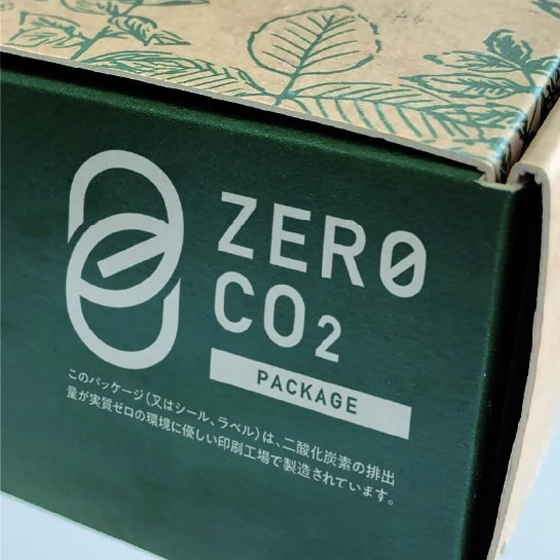
Three items that can be displayed
01Marking
 Marushin has established its own CO2 zero printing mark. You can choose from several marks. *See Appendix for mark types.
02Display of text
(Example of environmentally friendly text)
 In addition to "PACKAGE," "LABEL," "PAPER," etc. can be displayed according to the product type.
03Providing Evidence
 You can take advantage of the detailed content and links on our dedicated page showing the rationale for zero carbon printing.
*Items to be displayed can be any combination of (1), (2), or (3) depending on the customer's request.
Advantages to display
- You can promote your company as an environmentally conscious company to product purchasers.
- This can be used to raise environmental awareness among employees and business partners.
- It can contribute to the prevention of global warming, reduction of greenhouse gas emissions, and achievement of the SDGs.
At the head office
CO₂ emissions
| Electricity Consumption (January–December 2025): 3,211,779 kWh | CO₂ equivalent: 0 t* CO₂-free under the CO₂ reduction plan |
| Gasoline and Diesel Fuel Consumption (January–December 2025): 49,135 L | CO₂ equivalent: 117.23 metric tons |
| Gas Consumption (January–December 2025): 12,338 kg | CO₂ equivalent: 37.41 metric tons |
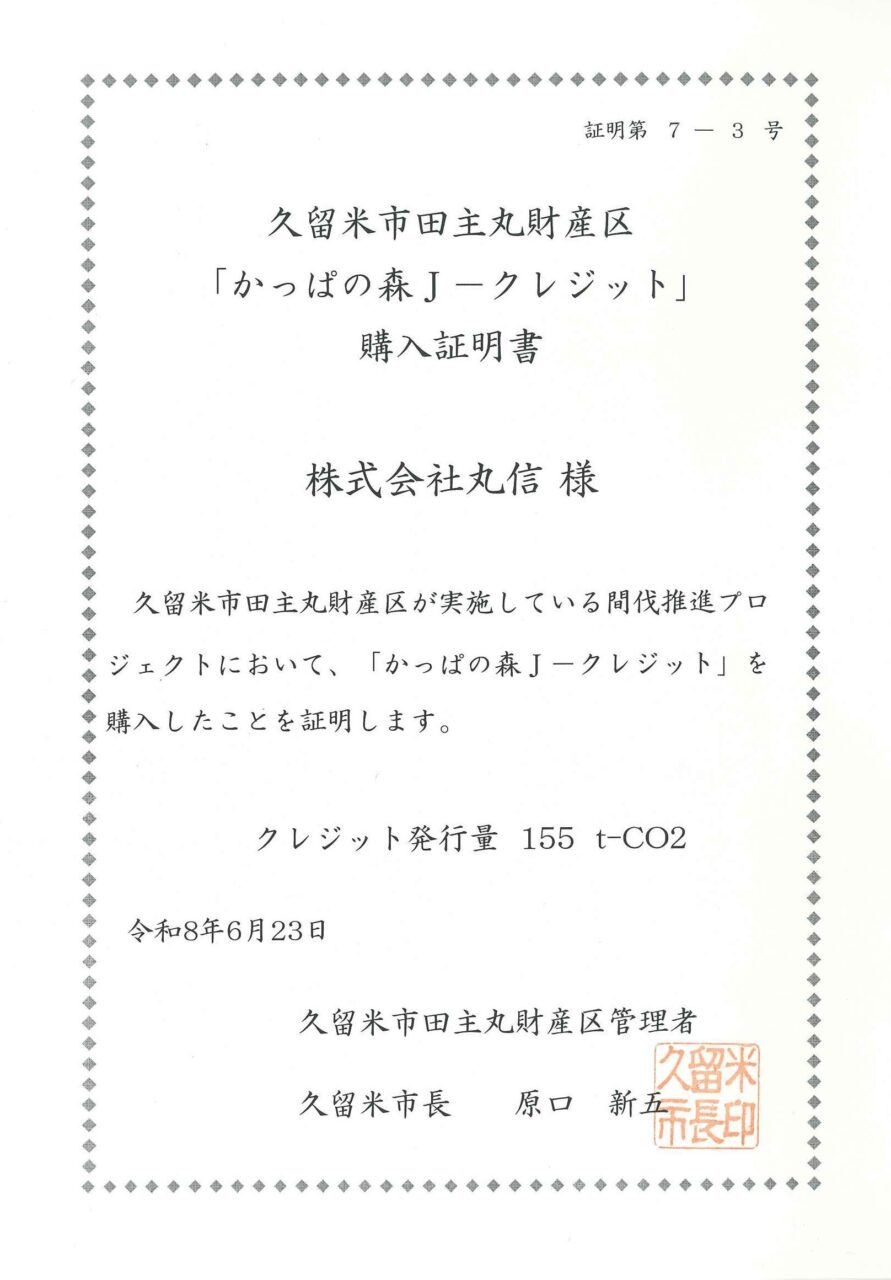
| CO₂ Emissions: Total 154.64 metric tons Purchase of J-Credits: Total 155 metric tons |
|
| CO₂ emissions (real): 0t |
A Better Future. Consumer and business awareness.
It is about to change.
- 01We want to actively incorporate environmentally friendly products as part of our corporate policy.
- 02I want to work for or with a company that works on SDGs
- 03Want to buy environmentally friendly products even if they cost a little more
- 04I want to contribute to society through the purchase of products.
Main Carbon Zero
initiative
Our main initiatives regarding carbon zero are as follows
-
Scope1
Direct emissions from company-owned equipment and vehicles are covered. This includes exhaust emissions from company-owned vehicles and fuel used by the company for transportation. Conversion of company vehicles to hybrids Kappa no Mori J Credit (CO₂ emission credits) purchase -
Scope2
Indirect emissions" are those in which the company consumes electricity, heat, etc. purchased from an outside company or organization. The use of electricity from an electric power company or gas from a gas company with which you have a contract falls under this category. renewable energy LED UV lamps for printing and drying -
Scope3
Indirect emissions, excluding Scope 2, of CO₂ generated throughout the supply chain are covered. This includes everything related to business travel, procurement, waste disposal, product use, and final disposal. Manufacture of environmentally friendly products using FSC® certified paper Conversion to RPF (recycled solid fuel) Recommendation of low environmental impact trays Effective use of dual-use wood molds -
Other Initiatives
Set targets in the "Renewable Energy 100 Declaration RE Action
Scope1
-
Conversion of company vehicles to hybrids
The company is promoting the introduction of hybrid vehicles, which reduce CO₂ emissions, and as of FY2020, hybrid vehicles will account for approximately 28% of company vehicles. As of FY2020, the ratio of hybrid vehicles was approximately 28%, and the plan is to convert 100% of these to hybrid vehicles by 2025. -
Kappa no Mori J Credit (CO₂ emission credits) purchase
We purchased "Kappa Forest J-Credits," equivalent to CO₂ emission credits, from Tanushimaru Property District in Kurume City. J-Credits are a system under which the Japanese government certifies the amount of CO₂ emission reductions and absorption from forest management projects by companies, municipalities, and other organizations as "credits. The Tanushimaru Property District of Kurume City owns and manages approximately 770 hectares of forest in the Mino Mountain Range located in southern Fukuoka Prefecture. Introduction of Kurume City Tanushimaru Property District "Kappa no Mori J-Credit" (Kurume City website)
Scope2
-
renewable energy
We switched to a renewable energy plan on July 1, 2021 for all electricity used at our headquarters office. This plan supplies CO2-free electricity from renewable energies by using electricity derived from renewable energy sources (hydroelectric and geothermal) owned by power companies and non-FIT renewable energy designated non-fossil certificates. This means that all electricity used at the headquarters office is also CO₂-free. -
LED UV lamps for printing and drying
While the switch to renewable energy has been completed at the company's plants, we will continue our efforts to reduce electricity consumption. In particular, the seal printing plant is switching to LED lamps for UV lamps for printing and drying, which consume a lot of electricity and generate heat, to significantly reduce both electricity and heat generation.
Scope3
-
Manufacture of environmentally friendly products using FSC® certified paper
It is believed that deforestation and land use change are responsible for 10% of the world's CO2 emissions, a greenhouse gas, from human activities during the period 2002-2011. By promoting FSC® certified products, a system that identifies wood produced from responsible forest management and its products and delivers them to consumers, we can contribute to the reduction of CO₂ emissions through forest conservation. As an FSC® certified mill, we encourage the use of FSC® certified paper. -
Conversion to RPF (recycled solid fuel)
Since July 2020, we have been working to reuse general waste by converting it into RPF (recycled solid fuel). Approximately 98% of what was previously disposed of as general waste is now used as RPF material, converted to solid fuel at an RPF plant, and reused by paper companies and others. -
Recommendation of low environmental impact trays
The Food Packaging Materials Division actively recommends trays and other products with low environmental impact that can be expected to reduce CO2 emissions. The volume of products handled has been increasing year by year, mainly products made from raw materials recycled by collecting and recycling once-used trays and recycled transparent containers and PET bottles made from collected PET materials, and the supply of these two products has resulted in a CO₂ reduction of approximately 895 tons during the period from March 2020 to February 2021 (calculated by container manufacturers). (calculated by the container manufacturer). -
Effective use of dual-use wood molds
In the package production process, printed cardboard is punched out as shown in the development diagram (Thomson process), and a wooden die (die) is essential for the punching out process. Whenever a new wooden die is made, electricity and heat are generated, so we recommend the use of a dual-use wooden die. For packages of general shapes and sizes, we recommend using our own wooden die, which reduces electricity and CO2 emissions generated during the production of the wooden die, and eliminates the costs associated with the production of the wooden die.
Other Initiatives
-
Set targets in the "Renewable Energy 100 Declaration RE Action
We are participating in the "Renewable Energy 100 Declaration RE Action," a new framework that aims to convert 100% of the electricity we use to renewable energy sources. We plan to switch to renewable energy by the end of this fiscal year at our directly contracted sites in Japan.