


quality control
quality control
Acquisition of ISO9001 and Japan Color Standard Printing Certification
ISO 9001
It is an international standard for quality management systems issued by the International Organization for Standardization (ISO). We acquired this certification in 2001. Based on this system, we strive to provide not only "quality control" and "quality assurance" but also better products (services) and to improve customer satisfaction.
Japan Color Standard Printing Certification

This certification is based on ISO international standards and certifies that stable printing can be performed based on Japan Color, the standard for printing colors in sheet-fed offset printing in Japan.
About Color
-
color management
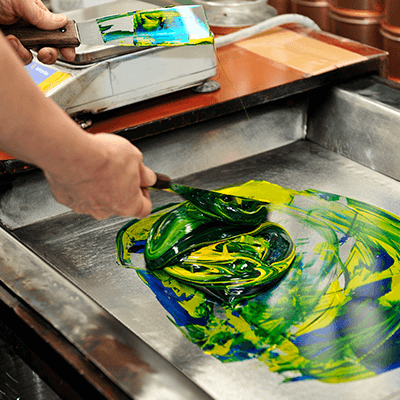
Since each printing press has its own color characteristics and color quirks, we have introduced a color management system (CMS) to check color reproduction consistently from input to output. Equipped with inkjet printers and other equipment for simple color correction, it is possible to check the printed image with color samples that are close to the desired color to some extent before printing the final product.
-
ink-making
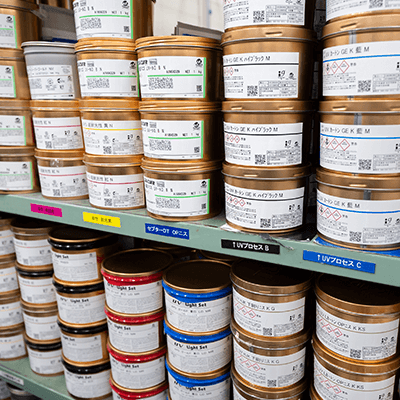
If the color sink or ink ride differs depending on the material used, it is necessary to create a base ink. We are equipped with CCM (Computer Color Matching) systems at each of our plants for mixing inks, and our skilled technicians are capable of mixing inks to meet customers' requests. We are able to reproduce a wide variety of colors because we maintain a wealth of past color mixing data.
*We have a complete line of color guide chips, including DIC, TOYO, and PANTONE. If there is a color you would like, or a color you would like us to pay special attention to, please let us know the manufacturer (00th edition) of the color guide book and the number of the color chip. Since there are subtle differences in color, addition of color chips, color schemes, etc., depending on when the book was manufactured, it is best to let us know which edition you are using so we can get a better idea of how the finished product will look.
Inspection System
Proofreading of manuscripts
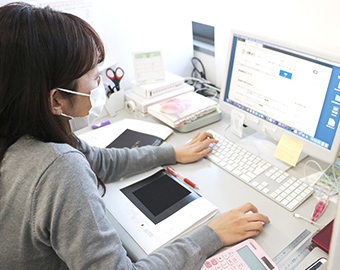
Before printing, we double-check the manuscript. We check for typographical errors and omissions in the text, correct the text as instructed, and for food-related manuscripts, we even have a qualified person check the food labels. After visual proofreading, we use digital inspection to check for unexpected changes.
Image Processing Inspection Equipment
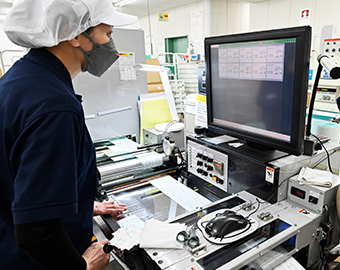
For labels and seals, for which a high level of quality is required, we have a system in place to ensure that even the slightest pinhole, misprint, or stain is detected and that no defective products leave the factory by making full use of image processing inspection equipment.
*Some printers may not be compatible.
Desktop inspection equipment
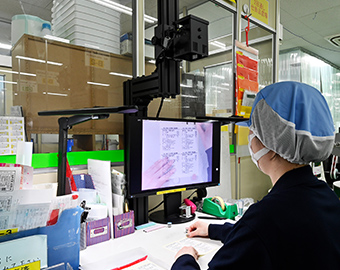
Desktop inspection equipment scans and reads labels to identify defective products such as ink skips, pinholes, stains, and foreign matter. This tabletop inspection system is suitable for customers who do not require in-line quality inspection.
*Options.
Blanks Inspection System
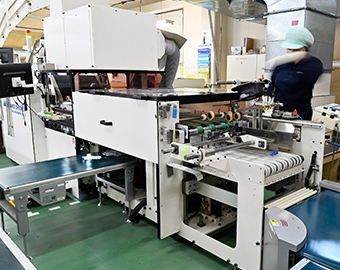
Printing defects such as small stains, splashes, water drops, blurring, scratches, etc. can be instantly inspected by CCD cameras on the front and back sides of the blanks after the punching process is completed. A pass/fail judgment is made according to the inspection level, and non-conforming products are automatically ejected.
*Options.
Inspection equipment for package printing
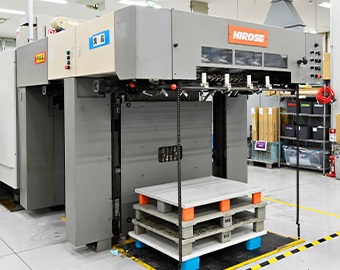
This is a paper inspection system for package printing, which requires high quality. High-quality printing is achieved by eliminating inevitable problems such as slight pinholes, smudges, and oil splashes on the printing press.
*Options.
Friction Resistance Inspection Equipment for Boxes
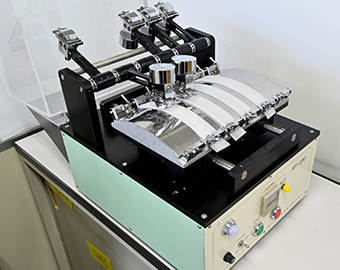
This is an inspection device for testing the abrasion resistance of products. The system can simulate the state of abrasion on the printed surface of a package due to transportation, etc., because it can check the state of the product when it is rubbed a certain number of times under a specified load.
*Options.
Printing Environment
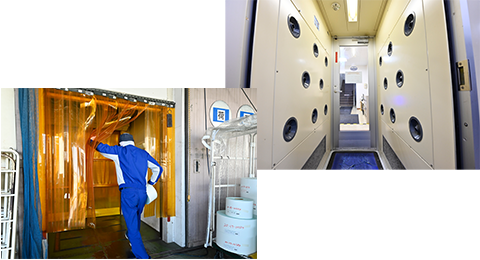
Temperature, humidity changes, air pressure, and other factors also change the condition of materials and inks. Ink becomes hard when the temperature is low and soft when the temperature is high, so either bias will not produce a good print. On the other hand, paper becomes static when the humidity is low, so it attracts dust during the printing stage, causing printing scratches. In order to produce stable labels and stickers throughout the year, the factory is air-conditioned to maintain a room temperature (25°C) and humidity (55%) suitable for printing. In addition, air showers, double shutters, insect traps, and other devices are used to thoroughly control dust and insects. In addition, as a factory certified as a "technologically excellent factory," we practice quality control backed by advanced technology and 5S activities on a daily basis to realize a better printing environment.
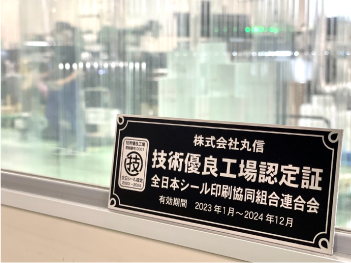
The first "Technological Excellence Factory" to be certified for its seal printing technology.
The "Technological Excellent Factories" certification system was established in 2017 by the All-Japan Federation of Seal Printing Cooperative Associations with the aim of improving the technological capabilities of seal printing factories. Since certification allows a company to publicize its own factory's technological capabilities and leads to trust in printing quality, the program aims to encourage printing companies to obtain certification and improve the technological capabilities of the industry as a whole.
To be certified, a factory must win an "Excellence Award" or higher in the seal label contest sponsored by the federation. Marushin became the first certified registered factory (registration number: 0001) after winning the "Minister of Economy, Trade and Industry Award," the highest award in Japan, at the domestic seal label contest in 2016, when the program was launched.
Upon certification, the factory is presented with a certificate (nameplate) plate, the certification mark is displayed on the company brochure, website, business cards, etc., is listed in the list of certified factories on the federation's website, and is also listed in the national membership directory.
Marushin is also promoting the fact that it is a "Technological Excellence Factory" by displaying the plate at its seal factories and the certification mark on its website and business cards, etc., to make people aware that they are a member of a company working at a "Technological Excellence Factory" and to further improve its technological capabilities in seal printing.
Click here for more information about the "Technical Excellence Factory" certification system.http://www.seal.gr.jp/news/170106.php
5S activities in the company
5S is a term taken from the five key words beginning with the letter "S" for "Seiri", "Seiton", "Seiso", "Seiketsu", and "Shitsuke", and has been actively adopted in the manufacturing and service industries in recent years.
- Organize": Distinguish between necessary and unnecessary, and dispose of what is not needed.
- Tidying up: clarifying where things are placed.
- Cleaning"...inspect as you clean.
- Cleanliness" ... keeping it clean.
- Discipline...follow the rules and make it a habit.
To improve the printing site environment and operational efficiency, we have established a dedicated in-house project and are working on company-wide 5S activities with the goal of "taking 5S activities to the next level.
Leaders are selected in each department to provide regular training and guidance.
The factory sets aside 30 minutes each day to work on 5S.
In addition, each department decides on a monthly theme and is required to report before and after 5S implementation.