


Sanpo-yoshi Communication
Sanpo-yoshi Communication
Printing Column] Dry weather makes paper thirsty too! Dry Down to Watch Out for in Winter
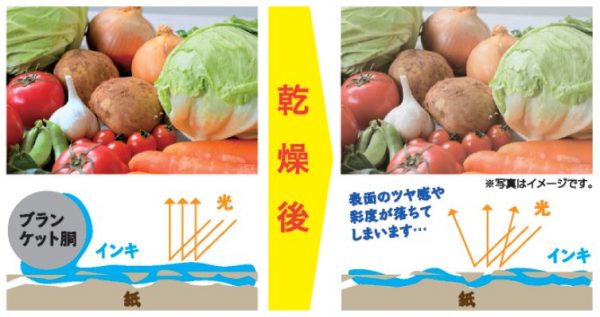
There are two types of printing: “UV printing” (where ink is cured using ultraviolet light) and “oil-based printing” (where the ink dries through oxidative polymerization, causing the moisture to evaporate), each with its own advantages and disadvantages. “Dry-down” is a phenomenon that occurs during “solvent-based printing” on materials such as washi (uncoated, moisture-absorbent paper).
When you sweat while wearing a T-shirt or similar garment, that specific area becomes darker and takes on a blackish hue. Similarly, if food containing a lot of oil gets on the garment while eating, that dark stain won’t come out. By the same principle, if the ink is oil-based, it gradually seeps into the paper as it dries, causing the area to gradually darken while the ink on the surface is absorbed by the paper, making the color fade. This is known as “dry-down” (the phenomenon where color fades as it dries).
The tricky thing about dry-down is that the color can look different “at the time of printing” versus “the next day.” I often get asked by people in the printing industry, “How should we match the colors?” I use golf as an analogy and reply, “It’s like putting—even pros sometimes miss from point-blank range.”
When you think a straight shot won’t go in, carefully observe the slope and predict whether the ball will curve to the right or left, and whether you should hit it harder or softer. When printing, I also try to anticipate how the print will change over time—for example, printing a bit lighter because the image will darken, or increasing the density because the color will fade—based on my intuition. The problem is that I won’t know the results until the next day, and even under the same conditions as the previous day, the results can vary each time (T_T).
When a new salesperson asks, “How should I explain the color dry-down?” I tell them, “Compare the Mira Coat and Premium paper samples from Marushin.” When I explain that even on Premium paper, the colors appear just as they do when printed on Mira Coat, they’re invariably surprised.
For reprints, we keep a copy of the original print—produced on paper that doesn’t dry down easily, such as coated paper or Miracoat paper—and use it as a reference. We also check how the ink has soaked in using a magnifying glass to ensure the reprint comes as close as possible to the original, even if it isn’t an exact match. For new editions, we use a microwave to observe color change trends and improve the accuracy of our predictions.
For materials such as washi or high-quality paper, UV printing—which prevents color shift (by curing the ink with ultraviolet light before it is absorbed by the paper)—results in more stable colors; however, since the ink is cured without penetrating the paper, it produces a glossy finish. If you want the ink to blend into the washi paper, oil-based printing is preferable; however, due to dry-down, the color tone will vary from lot to lot.
It depends on the customer's preferences, but both options have their pros and cons. Drydown is one of the printing phenomena that makes it difficult to judge color, but we intend to continue our research to improve accuracy.
(Hiraki, Director of Quality Control)