





Sanpo-yoshi Communication
Sanpo-yoshi Communication
Printing Column] Mystery of Ink Density
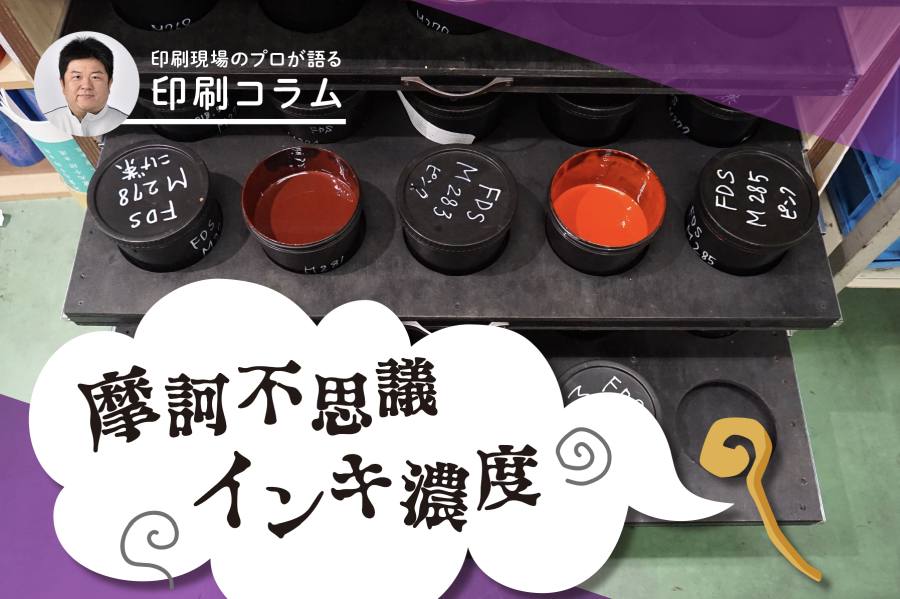
I am writing about "ink density" because I have recently received questions about it from field workers and sales people.
Operator "This print is not as black as the last one, no matter how much black ink I put on it.
The ink is on top of the gold ink, and the gold color can be seen through the black ink.
I "lower the printing pressure, lower the density of the ink, and squeeze out the water."
Operator "What? I want to make the ink darker?!"
I said, "Don't worry! Just do it!"
The print operator follows the instructions with trepidation. As a result...
Operator "The ink has thickened!"
1. if the printing pressure is increased in order to suppress the ink of the upper color from becoming dry, the gap will disappear and the ink below will not be visible, resulting in a darker ink.
(In the case of 2, ink staining will occur unless more water is used.
1 is the way to do each of these to make them darker, but if you do them at the same time, the color will be lighter.
(1) Increased printing pressure ⇒ The gap between the paper and the plate (or more precisely, the transfer from the roller called a blanket) becomes narrower, limiting the absolute amount of ink that can be supplied.
(2) If the density is increased, more water must be produced, which leads to emulsification (water mixing with ink) and thinner ink.
In other words, "lower the printing pressure, lower the ink density, and squeeze out the water" was an instruction to [reduce the ink density to make room for the ink supply and to reduce the amount of water].
Similarly, I was asked by a sales person, "Why can't I use 100% of all four colors [C (indigo), M (red), Y (yellow), and K (black)] to produce a deep black?" I was once asked this question by a sales person.
The conclusion is that colors become lighter and more blurred, and the risk of drying defects also increases.
The color with the strongest influence is K (sumi) out of [C (indigo), M (red), Y (yellow), and K (black)].
The black produced with such a distribution is called ”rich black” (it has a luxurious look). Another method is to apply two different editions of sumi ink.
However, since the appearance of black ink does not change even if the density is increased beyond a certain level, there may not be much difference even with a thick layer of black ink in one plate. If ink is applied too much, there will be no space between the ink and the color.
This results in unstable transfers and unevenness.
I think 8 minutes in the belly is important for everything.