







Sanpo-yoshi Communication
Sanpo-yoshi Communication
Printing Column] Learning from Failure

The other day, I worked on a project to create a gift box that required only foil stamping, with no printing. Since there was no printing, the key challenge was aligning the cut lines with the foil stamping.
Initially, we planned to cut the plain boxes using a sample cutting machine and then apply foil stamping using the ruled lines and cut lines as guides.
However, the design featured foil stamping along the score lines (where the paper is folded), and if the foil stamping had been done afterward, the unevenness of the score lines could have caused the foil to adhere poorly. Therefore, we changed the process to apply the foil stamping first and then perform the scoring and cutting.
Normally, registration marks are printed to align the foil and die-cut areas, but printing these marks increases the cost. If registration marks are instead added to the foil plate, the foil area increases, which in turn raises the cost of the foil plate.
So, instead of using registration marks, we decided to create the gift boxes using a method we had never tried before: performing the foil stamping and scoring and cutting operations based on the position relative to the edge of the paper. We printed a film showing the approximate alignment between the paper edge and the foil stamping plate, and then aligned the foil stamping plate with that film.
Later, when I heard that the box was being cut on the sample cutting machine, I went to check on the progress to see if it was turning out well. My heart was racing with excitement. There was almost no misalignment, and both the scoring and cutting had gone smoothly.
However, when I actually went to the production site, the processing situation was different. It turned out that the base paper we had ordered did not match the customer’s requested paper quality, so we immediately placed a new order, which ultimately caused a delay in the delivery date. During this time, to ensure we could meet any of the customer’s requests—whether they prioritized the delivery date or the correct paper quality—we produced three different versions: (1) the incorrect paper (first batch), (2) an alternative paper (just in case), and (3) the correct paper (final batch).
In the end, we were asked to use the correct paper even if it meant pushing back the deadline, but trying this new method three times actually had some positive outcomes. I went to check on the progress each time, and during those visits, I saw that both the foil stamping and the cutting processes improved with each attempt. That’s fantastic!
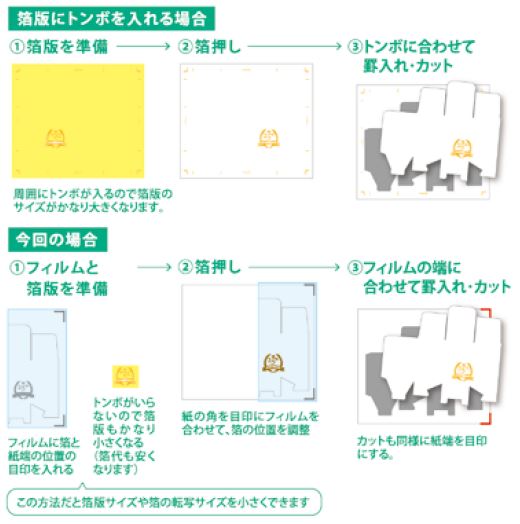
1. Since you’ll be aligning the paper from the edge, cut the paper a little shorter first (this makes it easier to align).
2. At first, when applying double-sided tape, I would stop the cutting machine once the guide lines were in place, apply the tape, and then resume cutting. However, by creating a window frame that fits the paper size and applying the tape there from the start, I can now do this without stopping the cutting machine.
While I can only reflect on my mistakes, I learned a great deal through trial and error. This experience has renewed my determination to put what I’ve learned to good use in the future. It also made me realize once again how much I am supported by so many people.
I received help from many people, including the customers who worked with us, the paper supplier who urgently provided the paper, and the on-site staff who not only carried out the work but also made improvements to ensure it was completed quickly and neatly.
I'm truly grateful.