



Sanpo-yoshi Communication
Sanpo-yoshi Communication
[Printing Column] Let's Make FSC (Forest Certification) Envelopes!!
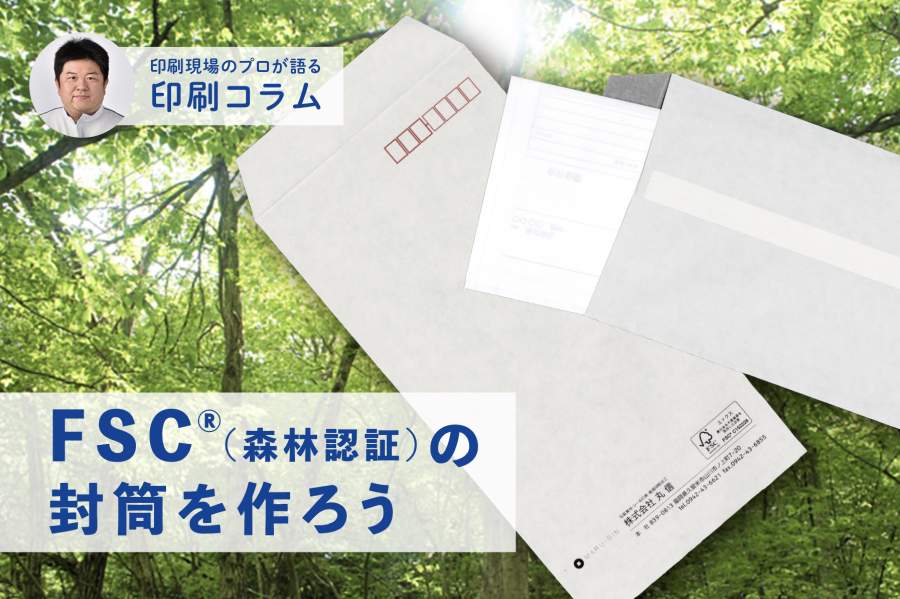
Recently, I’ve been seeing products with the FSC mark on all kinds of packaging more and more often. FSC stands for ”Forest Stewardship Council,” an international organization. It was established to address the serious issue of deforestation and promote sustainable and responsible forest management worldwide. The FSC label can be applied to products where every step of the process—from harvesting timber from the forest to manufacturing the final product—is properly managed.
Since our company holds FSC certification, the idea came up to use FSC-certified paper for our company envelopes and other items. We considered the following two methods for including the FSC logo on the envelopes.
① Request an FSC-certified subcontractor to produce the envelopes
② Print the materials in-house, then commission the bag manufacturer—with whom we have a contract as a subcontractor for FSC certification—to produce the bags.
*You may not display the mark unless you are a subcontractor that has entered into an FSC certification agreement.
When I immediately looked into point ①, I discovered that there were various restrictions. First, there were few paper options available. The paper intended for envelopes—which prevents the text inside from showing through—was not FSC-certified. Furthermore, I learned that for certified paper, since the FSC logo with the certification number is already printed on it, we cannot add our own FSC logo with our certification number.
*For FSC-certified products, the assigned license number indicates which company produced them.
So, we decided to look into option ②. With this method, the range of paper types we can choose from increases significantly. We also have complete freedom in terms of the printed content. However, the only challenge was figuring out how to design the envelope so that the text inside wouldn’t show through.
I figured I’d print on the inside of the envelope to keep the text from showing through, but when I did a test print… it shows through quite a bit (T_T)
To prevent the text inside from showing through, you need to use ink that doesn’t show through easily. This includes black, white, gold, and silver. I was concerned that white ink might let the contents show through if the text is dark, and that black ink might make the envelope’s surface look too murky, so I tried printing with silver ink, but it still shows through.
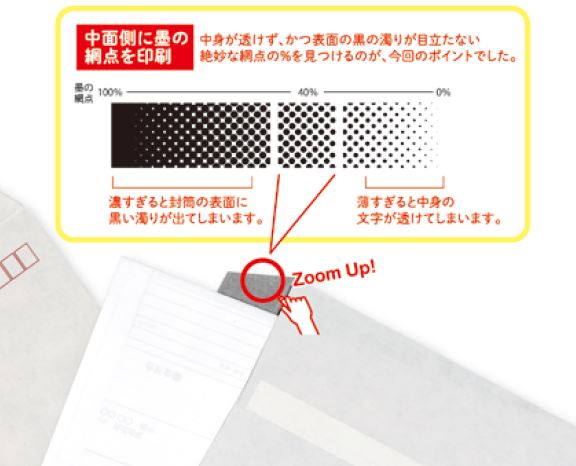
That’s when I came up with the idea of using a halftone pattern with black ink. By using black ink—which offers the highest light-blocking properties—and applying a halftone pattern, we can reduce the cloudiness that appears on the envelope’s surface. To determine the optimal screen percentage that would achieve both “preventing the text inside from showing through” and “minimizing the cloudiness on the envelope’s surface,” I printed test patches with screen tones ranging from 10% to 90% in the margins, using 40% as the baseline. At around 30%, the text inside was no longer visible through the envelope, but considering the range of density variations, we decided to use 40%.
Using this method, we can now produce envelopes that prevent the contents from showing through, even when using FSC-certified paper. Including the FSC logo on invoices and delivery slips is a great way to demonstrate our commitment to the environment. We’d like to thank the printing operators and prepress staff who helped us with this project.