




Sanpo-yoshi Communication
Sanpo-yoshi Communication
Key Plate” for Color Printing”
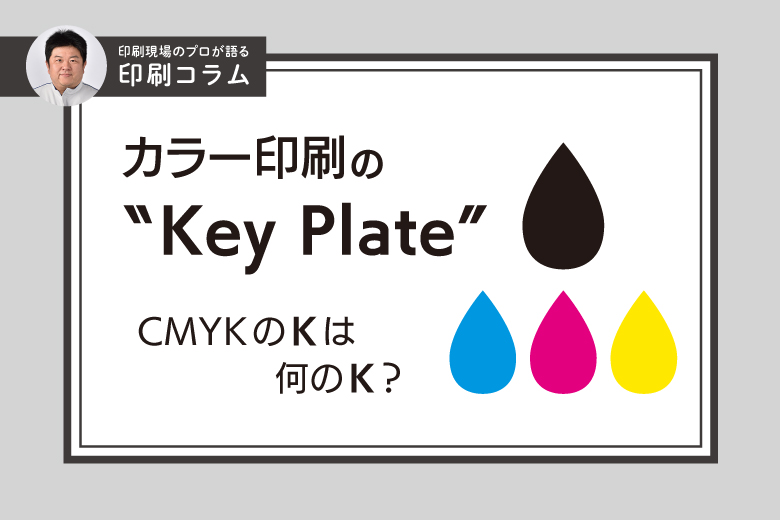
In this issue, we will talk about black ink, which is called "sumi".
I asked this question to a new print operator who has been with the company for three months.
The four primary colors in color printing are CMYK, where C is for cyan, M is for magenta, and Y is for yellow.
Then it replied, "K is for Kuro. Correct as a color, incorrect as a meaning.
CMYK is a common expression in the printing industry overseas, and black is Japanese. The correct answer is K for "Key Plate. It means the color that is key to producing solid black, such as outlines and letters. In the printing industry, black is often referred to as "sumi" (black ink).
Theoretically, it is said that 100% each of cyan, magenta, and yellow in color printing produces black, but in actual printing, the color is a dark gray with no crispness. This is where black ink, as a complementary color to black, becomes important.
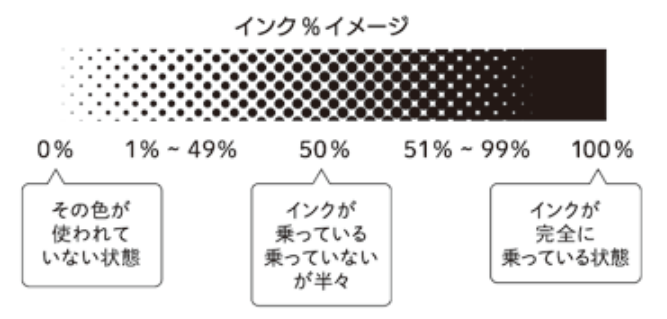
For example, to produce a brown color similar to black, 70% C, 100% M, and 90% Y will produce a blackish brown. However, it is not possible to make it darker or redder, because M cannot be higher than 100%. This is where black ink comes in.
As mentioned above, when three colors are multiplied, they serve the same purpose as black ink. Therefore, CMY is substituted with K. A rough explanation is shown in the image on the right (*The actual balance changes slightly depending on the color gradient of the sumi ink).
With M dropping from 100% to 40% and the addition of K, colors can be made darker or redder.
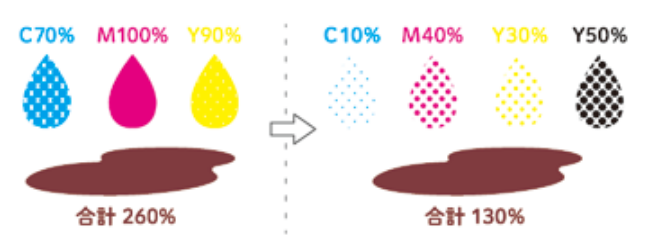
Yet another advantage. The first CMY is 260% total, and the changed CMYK is 130% total. The same color can be produced with about half the amount of ink. In other words, it saves resources and is good for the environment.
Also, less ink overlap means more stable color and better quality. I think that ink is truly a "Key Plate" these days.
Thanks for the ink.