



Sanpo-yoshi Communication
Sanpo-yoshi Communication
Printing Column] Merits and Demerits of Wooden Forms
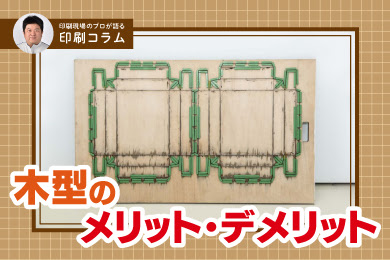
Die-cutting of packages is often done with a die-cutting machine called Thomson using a Thomson die (also called Biku die, but in our company it is often called a wooden die), and a spring blade or flexible die-cut (corrosion blade) is used for seals. Recently, laser cutting machines are also gradually being introduced because they can cut without using a dieboard.
In this issue, I will write about a wood pattern that you may or may not know.
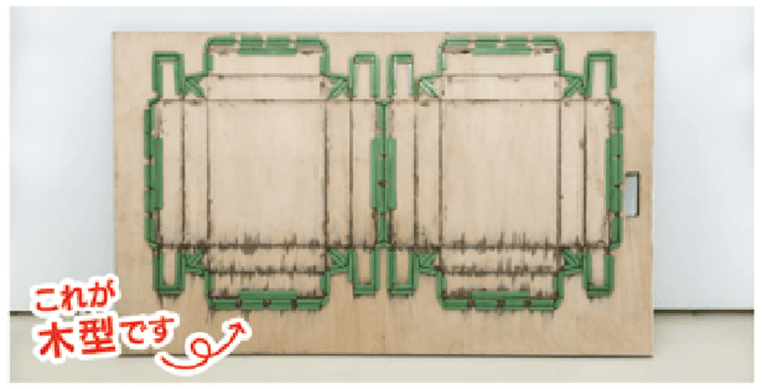
As the name implies, a wooden form is made of plywood (layers of wood compressed together to prevent bending), into which grooves are dug by laser or water jet, and into which blades, ruled lines (blades for folding), perforated blades (blades for perforating), etc. are inserted.
Although we hear from customers that wooden dieboards are expensive, in fact, wooden dieboards are developed as a method to create dieboards inexpensively because the price becomes five times or more when the same thing is created with a metal die.
The advantage of the other wooden forms is in the construction where the blade is fitted into the groove.
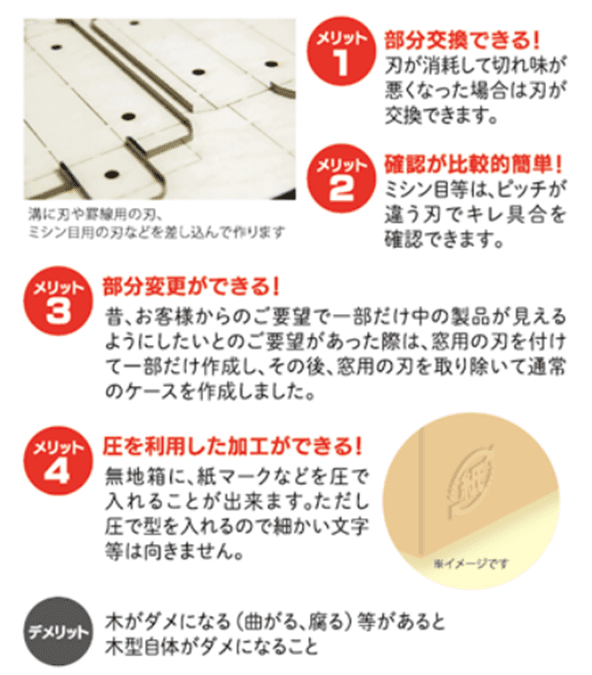
Plain boxes can be pressed with a paper mark, etc. However, since the mark is pressed into the box, it is not suitable for fine text, etc.
Disadvantage: If the wood is ruined (bent, rotted, etc.), the wooden form itself will be ruined.
As for the ruled lines (the part to be folded), there are various types and widths of blades and concave shapes, and changing the combination according to the use will change the box's workmanship and workability.
There are still many possibilities for technological improvement and we feel there is room for more research. We would like to continue our research in order to be of service to our customers.