



Sanpo-yoshi Communication
Sanpo-yoshi Communication
President's Column] Ethical, Profitable?
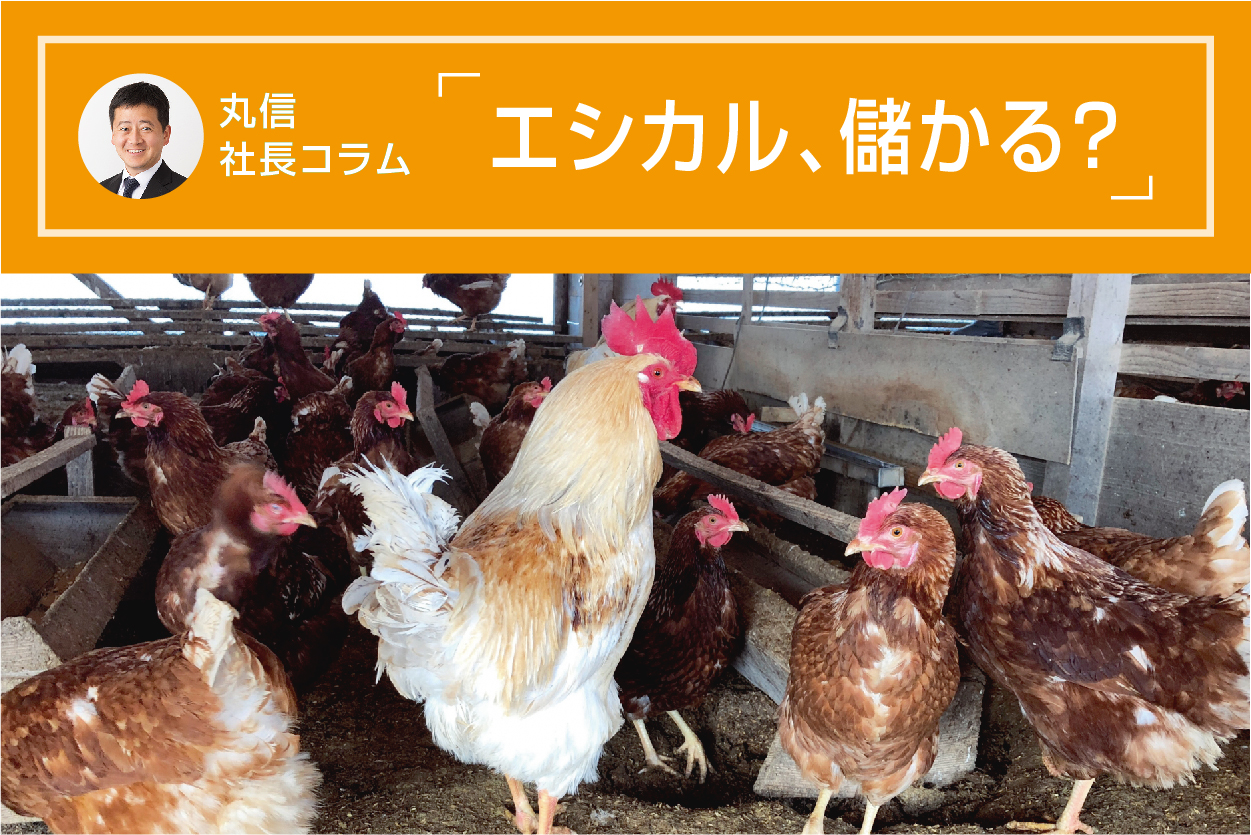
Last month's Nikkei Business magazine featured a feature article titled "Moukaru Ethical. Ethical consumption" is the practice of paying for things that are ethically good, such as those that protect the environment and human rights. In addition to the conventional selection criteria of quality and price, foreign capital and major companies are now adding ethical or not to their criteria.
I believe that labels and paper containers made of FSC-certified paper, which we recommend to our customers, are examples of such products. We are not sure whether consumers are actively choosing FSC-certified paper, but at least we have received many inquiries from companies that have placed orders with us, and I believe that we receive more orders than printing companies that are not FSC-certified.
This is becoming more prevalent in the food world. Take eggs, for example. In Europe and the U.S., there is a movement, especially among major corporations, to adopt eggs from hens raised in the "flat-fed" system from the viewpoint of "animal welfare. Even Starbucks and McDonald's, which consume large quantities of eggs, are planning to shift 100% of their eggs to "cage-free" eggs in the U.S., where chickens are not confined in small cages, due to pressure from animal rights activists.
It is expected that this wave will eventually hit the Japanese market as well. Japan's per capita egg consumption is 333 eggs, 1.2 times that of the United States. Poultry farmers have supported this "egg-consuming nation" through efficient egg rearing methods. It is not easy to invest in new facilities and equipment in a direction that reduces productivity while the cost of eggs remains high due to soaring feed prices. It will be very difficult for the entire industry to change.
Another key point is whether consumers will really choose eggs in stores, which will cost even more due to heirloom farming. Naturally, providing ethical products and services will cost more than ever before. If consumers recognize the value of such products and services, it will be possible to generate more profit than the cost. There may be some places that will buy a small amount of eggs, but in Japan, where the awareness of "animal welfare" is not well known among consumers, I think we will have to wait for a little longer.
However, SDG education for junior high and high school students is currently very active, and Japanese consumers will eventually mature and become more aware of the SDGs, which could lead to reverse selection through ethical consumption. It is important to keep one's antennae up while starting with what one can do, such as using FSC-certified paper.