







Sanpo-yoshi Communication
Sanpo-yoshi Communication
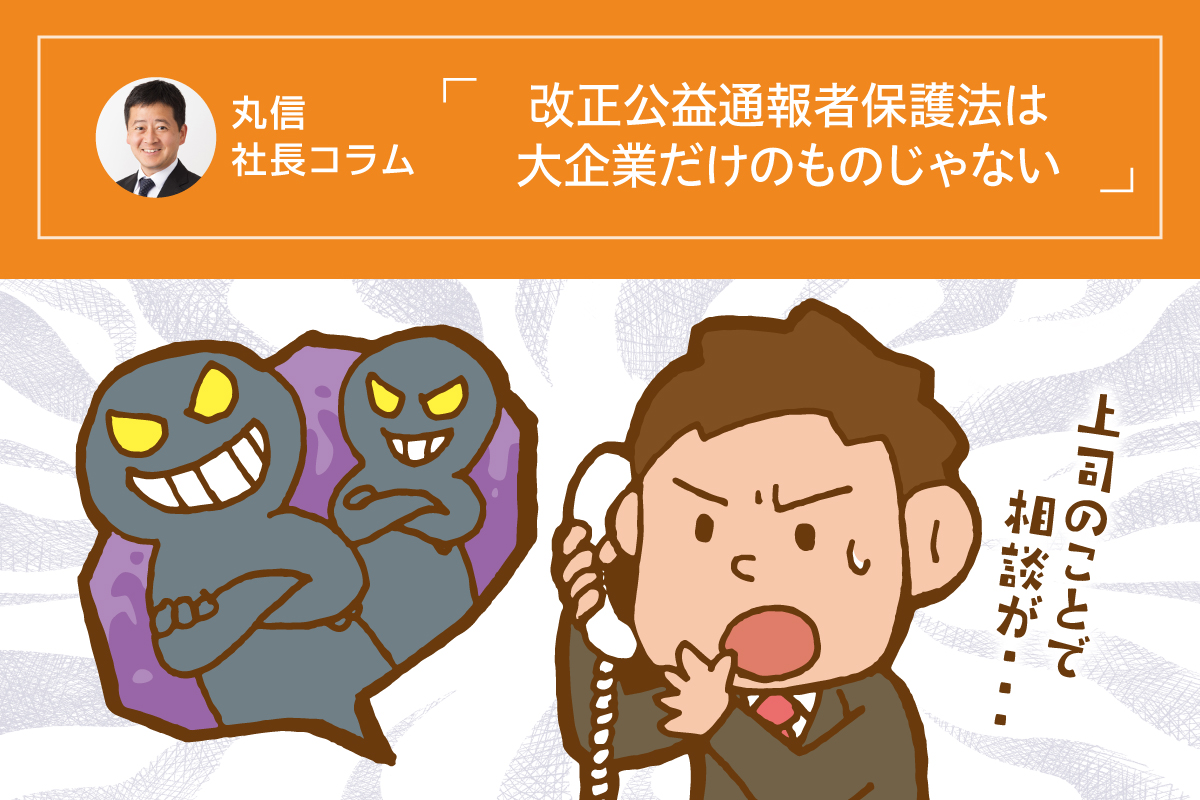
The Revised Whistleblower Protection Act Isn't Just for Large Companies
We sincerely appreciate your continued support. We would like to express our heartfelt gratitude to all of you who attended our exhibition last month.
At our recent management meeting, the General Affairs Department provided a briefing on the revised Whistleblower Protection Act. They reported that we will further strengthen our systems and ensure thorough awareness of the law both inside and outside the company.
When I talk with friends who are business owners, I often hear comments like, “We’re a small, close-knit company with about 50 employees, so it’s too early for us to set up a whistleblower hotline,” or “For small and medium-sized enterprises with fewer than 300 employees, isn’t this just a ‘best-effort’ obligation?”
It is true that, under the law, companies with 301 or more employees are required to “establish a reporting channel” and take other similar measures. However, when we examine the key points of the “Amended Whistleblower Protection Act,” which will take effect on December 1, 2026 (Reiwa 8), it becomes clear just how significant a business risk it poses to put this off, thinking, “Since it’s only a best-efforts obligation, we don’t have to do anything.”
What exactly are the legislative changes scheduled for December 2026?
Even though establishing systems is only a best-efforts obligation, "penalties and prohibitions" apply to all companies.
The most important point to note regarding this legislative amendment is that the new rules and strict penalties apply fully to “all companies,” regardless of their size.
- Introduction of New “Criminal Penalties” for Dismissal and Disciplinary Action
If an employer terminates an employee or imposes disciplinary action on the grounds that the employee filed a report, not only will such action be deemed invalid under civil law, but the employer will also face new criminal penalties. - Presumptive Provision Regarding “Disposal Within One Year” (Burden of Proof on the Company)
As a general rule, dismissals or disciplinary actions taken within one year of the date a report was filed are presumed to have been “based on the report.” Unless the employer can prove, with supporting evidence, that there were “objective reasons, such as gross misconduct,” the action will be deemed unlawful. - Prohibition on “Searching for the Culprit (Investigation)” and Obstruction of Reporting
Any attempts to identify “who made the report” or any attempts to silence individuals—such as by warning them that “you will face disciplinary action if you report this”—are explicitly prohibited.We are entering an era where, if you ignore employee complaints simply because there is no internal channel for them, or if you try to track down who made the complaint by asking, “Who said that?,” you will immediately face legal risks.
"Freelancers" Are Also Covered
Previously, protection was primarily limited to employees, executives, and former employees within one year of retirement; however, with this amendment, “freelancers (contractors)” and “freelancers within one year of the termination of their contract” have been explicitly added to the scope of protection.
If an external partner working alongside you on-site reports harassment or misconduct, taking actions such as “terminating the business relationship” or “reducing compensation” constitutes a serious violation of laws and regulations.
The “True Fear” Caused by the Lack of a Point of Contact
If there is no safe place within the company to seek advice, where should employees or freelancers who are facing difficulties turn?
SOS messages that employees can’t share with their company carry the risk of being leaked directly to “outside” sources, such as social media, labor standards inspection offices, and the media. Once a scandal erupts on social media or elsewhere, it may be too late by the time management becomes aware of it, and the company’s reputation—built up over many years—could be destroyed in an instant.
Furthermore, in recent years, there appears to be an increasing number of cases where large companies (prime contractors) are asking, “Does your company have a reporting hotline or protection policies?” The presence or absence of such systems may be becoming a criterion for continuing business relationships or selecting new contracts.
You might be thinking, “That said, we can’t afford to set up a dedicated department…” It seems there’s no need to create a large-scale system like the ones found in big corporations.
- Use external resources (such as agency services or lawyers)
People tend to be wary of internal contact points, fearing that “everything will be leaked to upper management.” With an external agency, you can reliably ensure anonymity and security at a low cost.
- Review of Pledges and Internal Regulations
We will clearly stipulate the rules—"Do not engage in witch hunts" and "Never treat whistleblowers unfavorably"—in our employment policies and other relevant documents, and ensure that they are widely communicated both within and outside the company.
- We, as business leaders, welcome "harsh criticism"
If a complaint is ever received, rather than trying to find the culprit, it seems important to view it as “they brought this to our attention while it was still a minor issue” and demonstrate a willingness to address the problem.
The internal reporting system is by no means intended to monitor anyone or expose scandals. It is a “vital firewall” designed to detect “small fires” that break out within the company at an early stage so that we can all work together to put them out.
Prompted by the legislative amendments scheduled for December 2026, I decided that rather than reacting to the law with a negative attitude, I would take a proactive approach to protect the company.
Marushin Corporation
Representative Director Yoji Hiraki