


Sanpo-yoshi Communication
Sanpo-yoshi Communication
What is letterpress printing?

The other day I was asked, "Letterpress and letterpress mean the same thing, right?" to which I replied, "They don't mean the same thing because they are different groups to compare. Letterpress is a form of printing in which type is rearranged, and the format of the plate is letterpress. Letterpress refers to all printing methods in which ink is placed on the convex part of the plate.
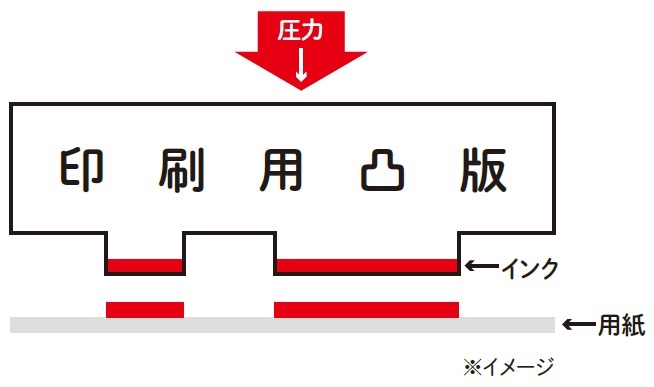
Say, "Do baseball and bat mean the same thing?" or "Do Japan and Fukuoka mean the same thing?" or "Do Japan and Fukuoka mean the same thing? Baseball" is the name of a sporting event and "bat" is one of the tools used in baseball. Japan" is the name of a country and "Fukuoka" is the name of a prefecture or a city, so they are not "equal" but "included" in the same meaning.
Let's discuss letterpress in more detail. Letterpress is a method of printing by using a type plate, a printing plate made of single letters or words of Chinese characters, alphabets, numbers or dots, which are combined to make a printing plate, which is then typeset to make a printing plate. Nowadays, this printing method can only be seen in museums and the like (in Europe, the Bible was printed by setting the letterpress in a wine grape press).
Although the method of cutting wood and printing it like a woodblock print is historically older, letterpress was later created as a technique for combining type to produce publications such as scripture and bibles. It is a printing technology innovation that is faster to make and rearrange type in advance than to carve wood each time. While there is a huge variety of type in the Kanji-speaking world, the limited variety of alphabets in Europe made it a suitable environment for letterpress printing. In Japan as well, Dutch books in the Edo period (1603-1867) were printed using letterpress.
All letters of the alphabet are back letters, and it is like preparing one [J ], two [A ], one [P ], and one [N ], which are type letterpresses, assembling them, arranging them in the order of [JAPAN], and printing them with ink.
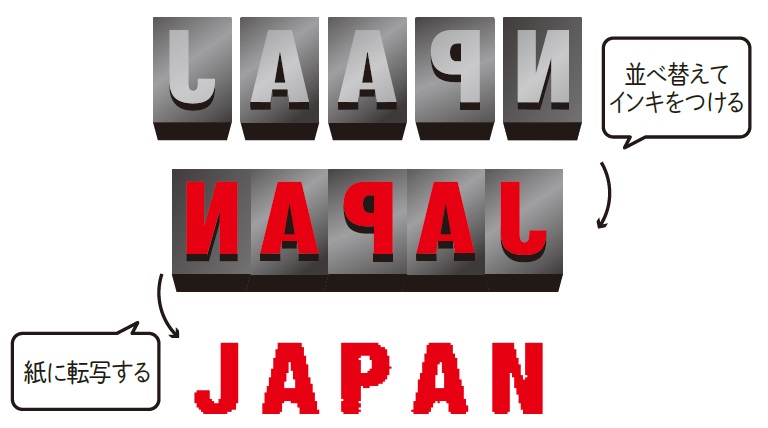
Later, typewriters were used for letterpress printing. This is a machine that prints type in sequence by adjusting the position of the paper and the plate, rather than rearranging the letterpress. Currently, we have one typewriter in our company. However, we do not perform the plate setting process to rearrange the type, but instead print using a resin letterpress with the letters and illustrations lined up as designed from the beginning. We refer to printing on an old-fashioned letterpress as letterpress printing for convenience.
Although the machine has some shortcomings, such as outlines around letters, blurring, and misalignment of letters, it is a very good machine for customers who enjoy it as a taste of old-fashioned printing. Printing today is based on various technological innovations, and we are grateful to our great predecessors who have developed printing over a period of more than 1,000 years.