



Sanpo-yoshi Communication
Sanpo-yoshi Communication
Electricity Bill Increase] What Power-Saving Measures Should Food Businesses Take Immediately?
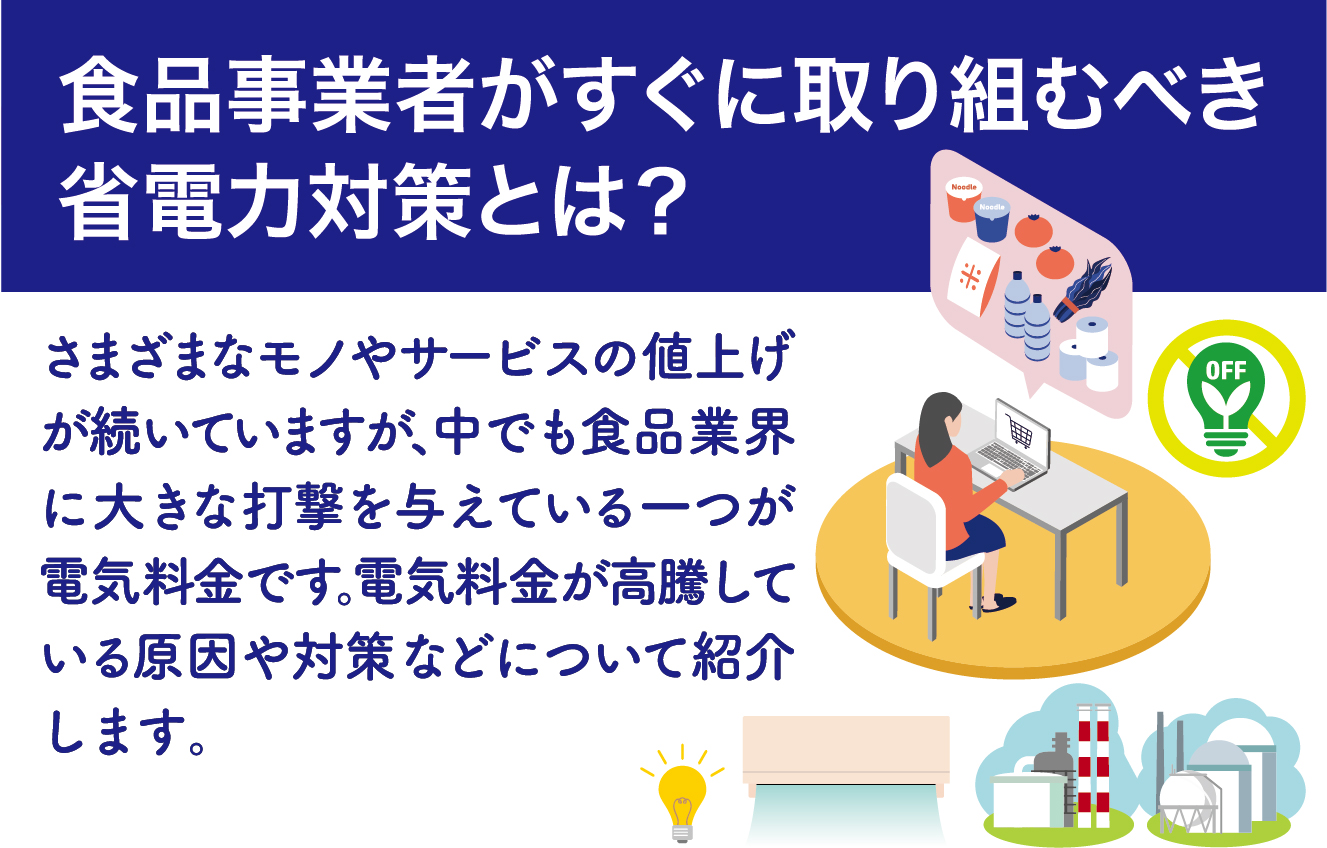
Prices for various goods and services continue to rise, and one of the most damaging to the food industry is the cost of electricity. In this article, we will discuss the causes of skyrocketing electricity prices, power-saving measures, and even the use of subsidies.
■Caused by soaring thermal fuel prices and nuclear power plant shutdowns, etc.
One of the factors that will cause electricity rates to rise is the soaring import prices of coal and liquefied natural gas, etc. According to data released by the Agency for Natural Resources and Energy in April 2022, thermal power generation accounts for 76.3% of Japan's power source composition. Since the country relies on imports for most of its thermal fuels, the structure of Japan's electricity supply is such that a sharp rise in the price of natural gas or coal will have a significant impact on electricity prices in Japan. The global economic stagnation caused by the spread of the new coronavirus, restrictions on Russian exports and imports following Russia's invasion of Ukraine, and the recent global push for decarbonization and the accelerated switch to natural gas, which emits less CO2 among fossil fuels, are also having a significant impact emissions.
In this connection, new power companies have raised their electricity rates. While it is easy for new power companies to lower electricity rates through their own rate setting, when the market soars, the price increases will be larger than those of other companies. Other factors contributing to the price hikes include the increase in the "renewable energy levy," which was created to reduce CO2 emissions and eliminate dependence on fuel imports, and the shortage of electricity supply in Japan. Domestic electricity supply decreased by 12.91 TP3T when comparing 2010 and 2020; after the Great East Japan Earthquake in 2011, many nuclear power plants continued to shut down their operations, resulting in a decrease to 86.51 TP3T compared to 2010.
Energy-saving measures start with air conditioning and lighting, and subsidies are also effective.
To reduce electricity costs for manufacturers, retailers, and other food businesses, it is a good idea to start with equipment, HVAC, and lighting.
While a balance must be struck between efficiency of factory operations and efficiency of air conditioning, efficient air conditioning can save on electricity costs. For example, if factory entrances and exits are left open in order to prioritize work efficiency, plastic curtains can be added, and in areas with high ceilings or too large work areas, power consumption can be reduced by narrowing down the area where employees work and enclosing it with plastic curtains. Removing obstructions from around outdoor units and avoiding direct sunlight can also save electricity. It is also important to maintain the recommended temperature settings of 28°C in summer and 20°C in winter. Body temperature should also be adjusted by employees' clothing, rather than by changing the temperature setting.
In addition, regular maintenance and the use of fans and circulators to circulate the air can also be expected to improve air conditioning efficiency. LED lighting is another measure that can be taken: replacing 60W incandescent lamps with LED lighting can reduce the cost of lighting by 85%. LED lighting has a long lifespan and can be replaced easily, saving not only electricity costs but also maintenance costs in the long run.
With soaring electricity prices and the trend toward decarbonization, energy-saving measures are being accelerated in air conditioning, lighting, and other manufacturing equipment. In order to encourage the introduction of energy-saving equipment, the national and local governments have a number of programs to subsidize introduction costs related to energy conservation and renewable energy, such as the "Subsidy for Energy Conservation and Demand Structure Transformation Support Project. These subsidies can also be used to counter electricity rate hikes.
Our dedicated grant consultants are available to assist you with grants and subsidies. Please contact us if you are interested.