





Sanpo-yoshi Communication
Sanpo-yoshi Communication
Printing Column] Fluorescent Ink and Lightfastness

Marushin has a system in place whereby workers in each production process review the drafts (design, specifications, and imposition) of new editions of products to identify problems in advance.

I said, "You should not use fluorescent ink in your calendars. The colors will fade quickly." (Lightfastness is important because calendars are basically for decoration.)
Fluorescent inks are very bright colors, so designs look great. However, because bright colors are easily exposed to ultraviolet rays, the pigments and dyes in the colors are easily damaged and fade.
In general, black and blue inks are resistant to ultraviolet rays, while red and yellow inks fade under ultraviolet rays. In some old signboards, only the blue color remains, but this is because the red and yellow colors have been lost due to fading.
There is also a type of ink called lightfast (weather-resistant) ink. This ink is slightly cloudier than normal ink. However, its lightfastness is stronger.
Later, our designer who designed this calendar said, "I designed this calendar based on the concept of using fluorescent colors effectively. Can you do something about it?" He asked us for advice.
When you hear the word "fading," you may imagine that the color fades, but in reality, it goes to the point where the color is gone. So, first of all, we had a look at the materials on fading.
I said, "If you're not good at this, all you'll be left with is ink and blue."
Designer: "I didn't think that far..."
Then the designer made a suggestion.

Interesting idea.
This method has several advantages.
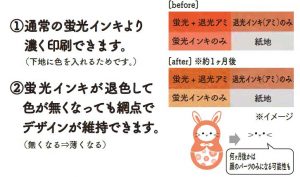
The only drawback is that it adds one more color. When I actually tried it, the result was better than I expected, and although I expected it to be a little muddy, the colors came out more clearly than I expected, and were a beautiful fluorescent color. When I showed it to the designer, he gave it a rave review! It was a great learning experience for me when I do fluorescent inks in the future. Thank you very much.